Hello. This is the Women's Medical Center at Mint Hospital.
When looking into uterine fibroid surgery, you will frequently hear the term 'robotic surgery.' However, even within the same Da Vinci robotic surgery system, not all operations are performed in the same way.
The robotic surgery that has been widely practiced in the past is the multi-port method, which involves making several small holes in the abdomen to insert individual robotic arms. In contrast, the recently introduced da Vinci SP (Single Port) is a dedicated single-port system in which a camera and multiple robotic surgical instruments are inserted together through a single incision.
The da Vinci X and Xi are representative multiport platforms designed to access a wide anatomical area, while the da Vinci SP is designed to allow the use of three articulated surgical instruments and an articulated 3D camera through a single port.
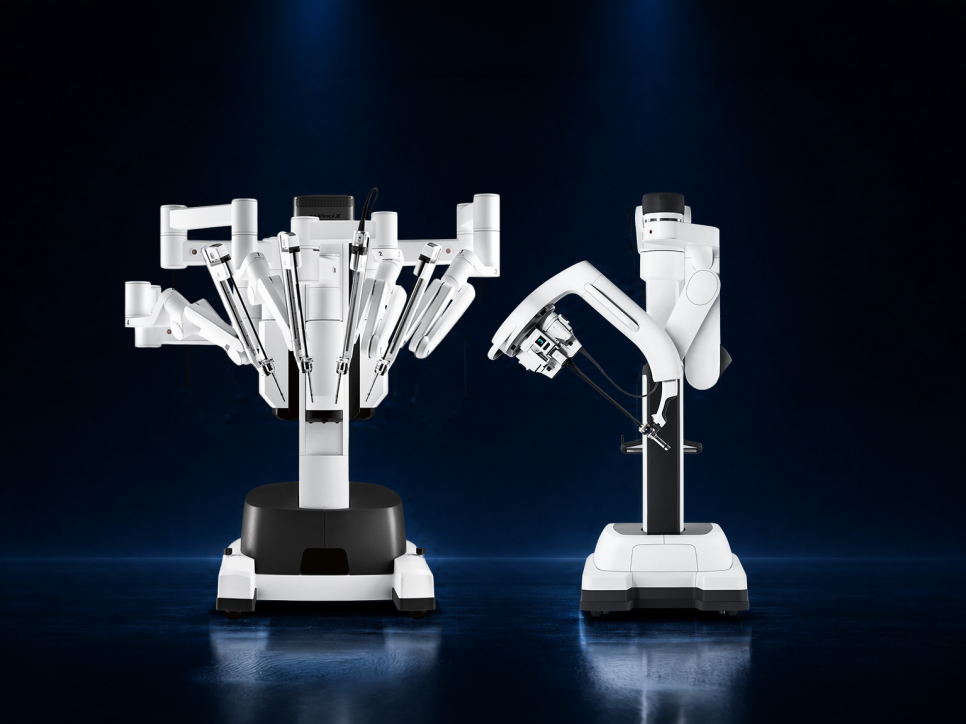
#Da Vinci robotic surgery system
From the patient's perspective, such questions naturally arise.
“Isn’t single-port robotic surgery, which leaves only one scar, unconditionally better?”
To start with the conclusion, that is not the case.
In uterine fibroid surgery, the most important factor is not the number of incisions, but rather how thoroughly the fibroids are removed while preserving normal uterine tissue as much as possible, and how precisely the uterine muscle layer from which the fibroids were removed is restored.
However, with the introduction of the da Vinci SP, the technical limitations of past single-port surgery can be largely overcome, and it is expected that the range of patients who can undergo single-port surgery will expand further.
'Multiport robotic surgery' performed through multiple small holes
The representative form of conventional da Vinci robotic surgery is the multi-port method. Multiple small incisions are made in the abdomen, and a camera and robotic arms are inserted from each location to perform the surgery. To use a simple analogy, it is like creating multiple doors and inserting a robotic arm one by one through each door.
A major advantage is that since each robotic arm can approach from different positions and angles, it is easy to secure a wide gap between surgical instruments, allowing for free movement across a wide surgical range from the front to the back of the uterus.
Advantages of multiport robotic surgery
- Easy access to surgical instruments independently from multiple directions
- Advantageous for securing a wide surgical range
- Highly useful for large or multiple fibroids
- Good for securing various angles in complex myometrium suturing.
- It has been used in various surgeries for a long time, so sufficient clinical experience has been accumulated.
On the other hand, multiple small incisions are required in the abdomen because several surgical instruments are inserted at different locations.
From the patient's perspective, the concern about "how many scars will remain on the abdomen?" is just as significant as the burden of the surgery itself, and this is precisely why they are interested in single-port surgery.
'Single-port surgery' leaving only a single scar—but why wasn't it performed on all patients?
Single-port surgery, as the name suggests, is a surgical method performed primarily through a single incision around the navel. From a patient's perspective, it is quite attractive. Instead of leaving multiple scars throughout the abdomen, patients can expect greater aesthetic satisfaction because the procedure is accessed through a single site.
However, the situation is different from the surgeon's perspective. Conventional single-port laparoscopic surgery had structural limitations because the camera and various surgical instruments entered through almost the same single passage, which restricted the angle of movement of the instruments and made them prone to colliding with each other.
To use an analogy, it is similar to inserting several long chopsticks through a single narrow door—rather than having several people each put their arms through different doors—and having to grasp, cut, and sew tissues facing different directions.

#Da Vinci Robotic Surgery SP Single-Port System
While it may be possible in simple surgeries, the difficulty can significantly increase if the fibroids are large, deeply embedded, or multiple. In particular, myomectomy does not end with merely removing the fibroids. Since a deep defect in the uterine muscle may remain where the fibroids were removed, the process of meticulously suturing the myometrium in multiple layers to stop bleeding and restore the shape and strength of the uterus is crucial.
Women planning to become pregnant in the future should be even more cautious.
Therefore, if the surgeon's movement or the suturing angle is excessively restricted to reduce a single scar, it may actually be difficult to consider it a beneficial surgery for the patient.
This is why the Women's Medical Center at Mint Hospital did not unreasonably insist on single-port laparoscopic surgery for every patient simply because it leaves 'minimal scarring.' It is because the quality of the surgery takes precedence over the surgical method.
How is the da Vinci SP different from conventional single-port surgery?
The biggest feature of the da Vinci SP is that it maintains the advantages of a single-port system while compensating for the manipulation limitations of conventional single-port surgery with robotic technology.
The SP allows three multi-jointed surgical instruments and an articulated 3DHD camera to enter together through a single port. Although they enter through a single passage under the skin, once inside the abdominal cavity, each instrument can unfold and bend in different directions to move.

#Da Vinci SP Robotic Surgery System
Simply put, while conventional multiport robotic surgery involves robotic arms entering through separate ports, the da Vinci SP features robotic arms that enter through a single port and then spread out in multiple directions inside the body. The camera is also designed to move using joints rather than simply looking straight ahead, allowing for a variety of viewing angles even within narrow access passages.
This technology is significant because it can improve upon the interference between surgical instruments and limited maneuvering angles, which were the most challenging aspects of conventional single-port surgery. In fact, a study on myomectomy using the da Vinci SP reported that single-port robotic myomectomy is a feasible method; the research team assessed that by addressing the ergonomic and operational limitations of existing single-port laparoscopic myomectomy, it has the potential to expand the scope of application for the procedure.
Is the biggest advantage of the Da Vinci SP just 'one scar'?
The first advantage of a single port that patients experience is, of course, the incision.
Many patients undergoing uterine fibroid surgery are relatively young women, and a significant number plan for future pregnancy and childbirth. Consequently, the burden of abdominal scarring cannot be ignored. The SP method offers the advantage of minimizing the abdominal incision area compared to the multi-port method, as it allows for surgery to be performed through a single main incision. In fact, the aesthetic aspect is reported to be one of the significant advantages of SP surgery in the field of gynecology.
However, if you view SP simply as "one-scar robotic surgery," you miss the core point. The truly significant change is that, despite being a single-port system, the robotic arms and camera can move inside the body using joints. In the past, surgeons often had to choose between creating a small scar for the patient and securing a sufficient surgical angle. SP can be seen as a platform that has significantly narrowed the gap between these two conditions.
In other words, the possibility of considering single-port robotic surgery has expanded even for some patients who previously chose multi-port robotic surgery because they deemed single-port access too difficult.
In that case, is the Da Vinci SP a better robot than the Multiport?
Is it true that because the SP is the latest equipment, it is unconditionally superior to the Da Vinci X, and that it is better to operate on the SP for all uterine fibroids?
No, it isn't.
It is best to understand the two systems as surgical platforms with different areas of expertise, rather than simply as being in a relationship of superiority or inferiority.
Since the multiport allows each robotic arm to enter from a different location, it secures a wide workspace and still has strengths in strong traction or suturing from multiple directions.
Conversely, the SP retains the fundamental structural characteristic that surgery must be performed through a single passage. Therefore, the multiport method may be more suitable for very large fibroids, multiple fibroids spread throughout the uterus, cases where severe adhesions are anticipated, or when a wide surgical scope must be secured from multiple directions.
Furthermore, while the use of the da Vinci SP is expanding in the field of gynecology, clinical evidence, including for myomectomy, is still in the process of accumulating compared to existing multiport systems. Although recent studies have demonstrated the feasibility and safety of the SP, it is not yet at a stage where it can be definitively concluded that it is superior to multiport systems in all surgical outcomes.
Which patients can undergo SP single-port robotic surgery?
Whether a single port is suitable cannot be determined based solely on the size of the fibroid. A comprehensive assessment is required, taking into account the size, number, location, and depth of the fibroids, the overall size of the uterus, the possibility of adhesions from previous surgery, co-existing conditions such as adenomyosis or endometriosis, and future pregnancy plans.
For example, even for similar 5cm fibroids, the difficulty of surgery differs completely depending on whether the fibroid protrudes outside the uterus or is located deep within the uterine muscle layer. The same applies to cases where a single fibroid is removed, as well as cases where multiple fibroids located in the front and back of the uterus are identified, removed individually, and sutured.
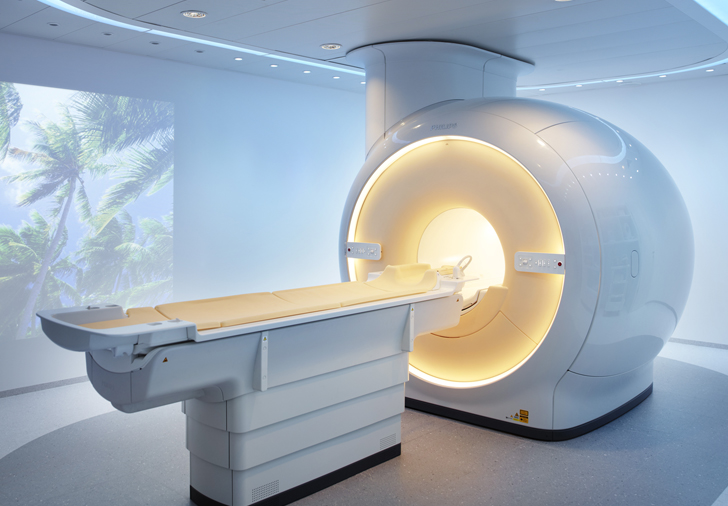
#Ingenia_3T_CX_MintHospital MRI
Therefore, rather than relying on simple criteria such as "up to a certain cm range for SP," it is important to determine the surgical method after accurately identifying the location of the fibroid and the structure of the uterus through precise imaging tests like MRI.
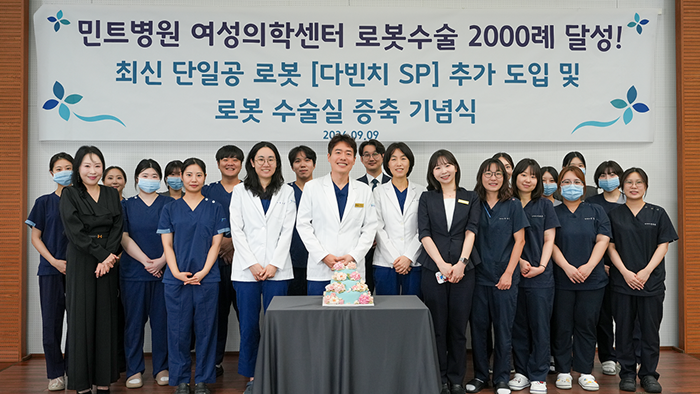
Mint Hospital Adds a New Option, SP, to 2,000 Cases of Robotic Surgery Experience
For over 20 years, the medical staff at Mint Hospital’s Women’s Medical Center have treated gynecological tumors and women’s diseases, placing great importance on surgeries that preserve uterine function and save normal uterine tissue as much as possible.
While the cosmetic advantages of single-port surgery have been clear, forcing its application to patients for whom it is difficult to secure sufficient surgical angles and precise suturing with the conventional method was not considered a choice in the best interest of the patient. Therefore, considering the size, location, and number of fibroids as well as the difficulty of the surgery, multi-port robotic surgery or conventional laparoscopic surgery has been selected when it was determined to be safer and more precise.
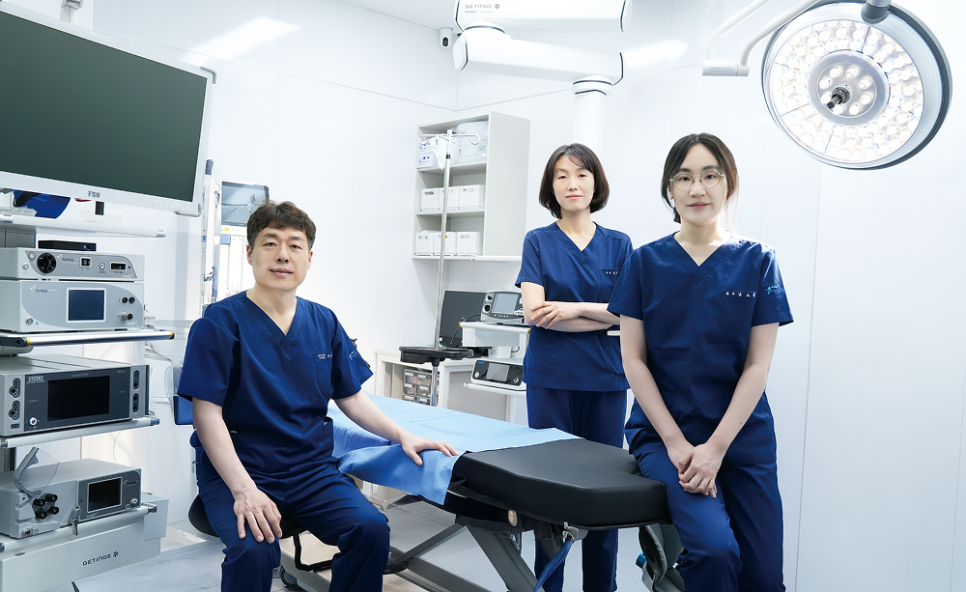
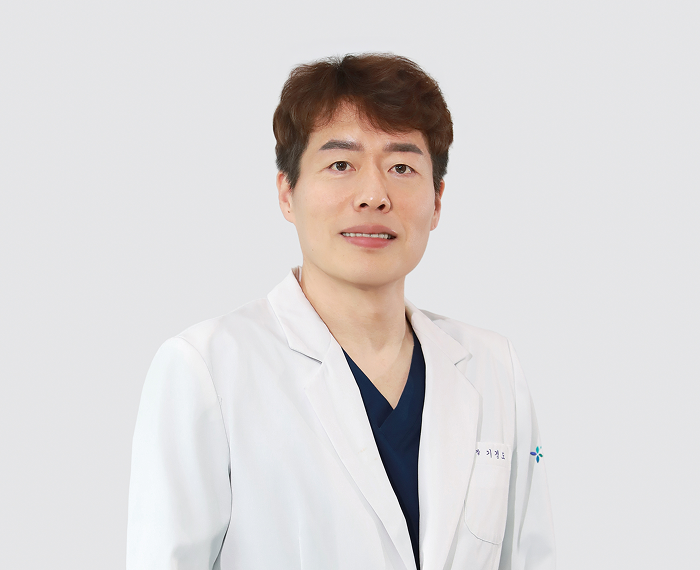
#Mint Hospital Women's Medical Center OB/GYN Medical Staff
The Da Vinci SP, newly introduced by Mint Hospital, is expected to bring about a significant change to these options. Because it allows for the independent movement of multiple articulated robotic mechanisms within the body while utilizing a single incision, it expands the scope for considering single-port robotic surgery even for certain fibroids that were previously difficult to access with conventional single-port methods. Research on myomectomy using the Da Vinci SP also suggests the potential to expand its application range by improving upon the operational limitations of existing single-port surgery.
However, the goal is not to operate on every patient using the SP method. The most important significance of introducing the SP is to reduce unnecessary incisions for the patient without compromising the quality of the surgery.
What is more important than a single scar is 'surgery suited to my uterus'
From a doctor's perspective, the number of incisions does not determine the quality of the surgery. The most important aspect of uterine fibroid surgery is to sufficiently remove the fibroids and accurately restore the uterine muscle layer while preserving the normal uterus as much as possible.
In conventional single-port surgery, the movement and angle of instruments were restricted depending on the location of the fibroid or the difficulty of the operation, making it difficult to recommend the procedure to patients. However, the da Vinci Robot SP is expected to significantly address these technical limitations of single-port surgery, expanding the range of patients who can benefit from the advantages of the single-port method while maintaining surgical precision.
Mint Hospital Women's Medical Center
20,000 integrated cases of uterine and ovarian disease treatment
2,000 Da Vinci robotic surgeries
4 surgery specialists and Doctors of Medicine
Diagnostic Imaging & Collaborative Radiology Specialists, 3
Two specialists in Anesthesiology and Pain Medicine
One-stop multidisciplinary care and hybrid treatment
2-Year Guarantee System for Uterine Fibroids Treatment
Inpatient ward nursing grade: highest A grade (all nurses)
Mint Hospital provides only essential treatments!