#Varicose veins are a vascular disease.
Varicocele is a condition in which the veins around the testicles become abnormally enlarged and blood flows backward.
Although the name might sound like a urological disease, if you look at the mechanism of its occurrence, it is a venous circulation disorder caused by the inability of venous blood to flow smoothly out of the testicles.
Varicocele is not a rare condition. It is found in approximately 15% of adolescent and adult men, and it frequently occurs on the left side. While most cases are asymptomatic, some may present with testicular pain, atrophy, or abnormal semen analysis, which can be a cause of male infertility.
Why does varicocele occur?
Blood from the testicles travels up toward the abdomen through the veins.
During this process, the valves and vascular structures within the veins help prevent blood from flowing backward; however, if blood flows backward due to the function or anatomical structure of the veins, the pampiniform plexus around the testicles stretches, causing varicocele.
In particular, unlike the right side, the left testicular vein is connected to the left renal vein, making it susceptible to the effects of venous pressure. In fact, about 80–90% of varicoceles are observed primarily on the left side.
Varicocele is not merely a problem limited to visible blood vessels. Stagnation of venous blood around the testicles can lead to changes such as elevated scrotal temperature and oxidative stress, and in some men, it can affect sperm count, motility, or the status of sperm DNA.
How do the symptoms of varicocele manifest?
There are quite a lot of cases where there are no symptoms even if varicocele is present.
If symptoms appear, the following forms are relatively common.
- Tunneling blood vessels are visible or palpable in the upper scrotum
- One testicle appears smaller than the other
- A heavy or pulling sensation in the scrotum
- Dull pain that worsens after standing for a long time or activity
- Pain or discomfort decreases when lying down
- Discovery of abnormalities in semen analysis during infertility testing
In particular, varicocele pain often manifests as a heavy, pulling, or aching sensation rather than a sharp, stabbing pain.
Conversely, if the pain is sudden and severe, or if the pain intensifies even with the slightest touch, other causes such as epididymitis, orchitis, or testicular torsion must be checked. Sudden, severe testicular pain may require an emergency evaluation.

#Symptoms of varicocele include dull pain, protruding blood vessels, and a stiff, heavy sensation.
Does having varicocele mean everyone becomes infertile?
No, it isn't.
Having varicocele does not mean that everyone develops sperm problems or experiences infertility. Many men go through their entire lives without any significant issues.
However, varicocele is a condition well known to be associated with male infertility, and treatment may be considered, particularly in infertile men with palpable clinical varicocele and confirmed semen analysis abnormalities.
The AUA·ASRM and European Urological Association guidelines also recommend considering treatment in men attempting to conceive who have palpable varicocele accompanied by abnormal semen analysis. Conversely, standardized treatment is not recommended if the semen analysis is normal and asymptomatic, or if the varicocele is latent and visible only by ultrasound.

#Varicose veins are the number one cause of male infertility.
Will exercising make my varicocele worse?
Veins may become more prominent or feel heavier after weight training or exercises that increase abdominal pressure.
However, there is not sufficient evidence to conclude that exercise itself accelerates the progression of varicocele.
If you do not experience pain or discomfort, it is advisable to adjust the intensity of your exercise according to your symptoms rather than stopping immediately, and if you have been diagnosed with varicocele, it is recommended to regularly check the condition of your testicles.
How is varicocele examined?

#VaricoseVeinsSelfCheck!
1. Examination
Varicocele is typically assessed by examining the testicles and scrotum while the patient is standing, and if necessary, evaluating whether dilated blood vessels can be felt while performing the Valsalva maneuver (tensing the abdominal muscles).
Clinical grades are also classified based on how distinctly the blood vessels are palpable.
2. Doppler ultrasound
Testicular Doppler ultrasound is useful for evaluating testicular size, the degree of venous dilation, and blood reflux.
It is particularly helpful in cases where diagnosis is difficult based on physical examination alone, when there are differences in testicular size, or when differentiation from other scrotal diseases is necessary. Ultrasound is also used to evaluate testicular volume and venous reflux in adolescents.
3. Semen analysis
If you are planning a pregnancy or are concerned about infertility, through a semen analysis
sperm concentration
운동성
form
Evaluates the back.
When deciding whether to treat, it is important to consider not only how large the blood vessels appear but also the severity of the varicocele, semen analysis, symptoms, and pregnancy plans.
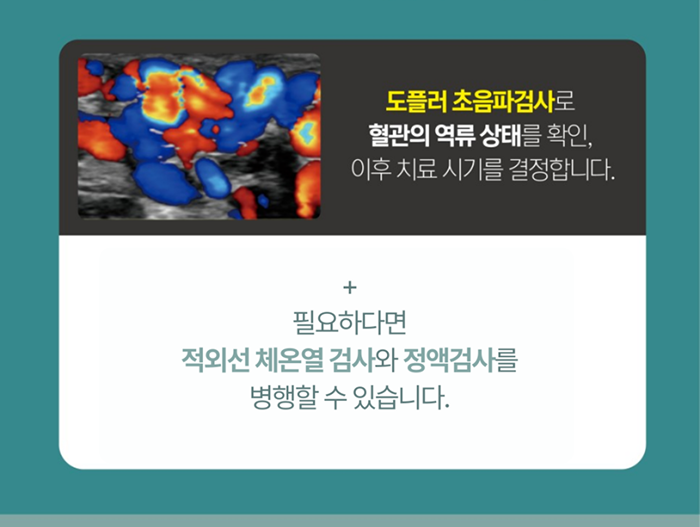
Varicocele can be accurately diagnosed through Doppler vascular ultrasound.
Is treatment absolutely necessary for varicocele?
Just because varicocele is discovered does not mean everyone needs to be treated immediately.
If there is no pain, no problem with testicular size, and the semen analysis is normal, regular monitoring is possible.
Conversely, treatment may be considered in the following cases.
- If you have persistent or recurring testicular pain
- If you are trying to get pregnant but it is not going well
- Cases where palpable varicocele and semen analysis abnormalities occur together
- Cases where one testicle continuously shrinks in adolescents
- When varicocele is very large and causes discomfort
In adolescents, it has not been proven that early treatment is always advantageous simply because of the presence of varicocele.
The European Urological Association suggests confirmed persistent testicular size reduction as a major criterion for treatment consideration.
Varicocele Treatment ① Microscopic Surgery
Varicocele surgery is a method of locating the veins causing reflux and tying them off or blocking them.
Currently, microscopic varicocele resection, which involves making an incision in or below the groin to differentiate blood vessels under a microscope and ligate the problematic vein, is widely performed.
Using a microscope allows for the selective treatment of veins while preserving testicular arteries and lymphatic vessels, which is advantageous for reducing complications such as recurrence or hydroceles compared to conventional non-microscopic surgery.
The anesthesia method may vary depending on the patient's condition, the hospital, and the surgical procedure.
Varicocele Treatment ② Embolization: Treatment within the blood vessel without incision
Varicocele embolization is a vascular interventional treatment performed in the Department of Interventional Radiology.
Instead of making a large incision in the skin, a thin catheter is inserted into the vein, and after identifying the reflux pathway of the testicular vein using angiography equipment, the problematic reflux is blocked using embolic materials such as coils or sclerosants.
This treatment does not block the normal testicular artery, and after treatment, venous blood from the testicle circulates through other normal venous pathways.
At Mint Hospital, after examining the patient's vascular structure and condition, the procedure can be performed by accessing the area through the arm vein, and the method and duration of the procedure vary depending on the individual's vascular structure and the scope of treatment.
Embolization has the advantage of a very small skin incision and rapid recovery, allowing most patients to return to their daily lives relatively quickly.

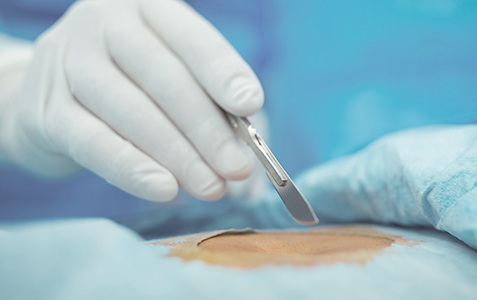
Upper varicocele embolization / Lower varicocele surgery
Is the recurrence rate higher with embolization than with surgery?
When comparing treatment methods, it is difficult to simply say that “embolization is always lower” or “surgery is always better.”
In a 2022 meta-analysis comparing surgery and endovascular treatment, recurrence rates and pregnancy outcomes were similar for both treatments, and overall adverse events were lower with endovascular treatment. On the other hand, another meta-analysis in 2025 showed that while recurrence was slightly higher with embolization and sclerotherapy than with surgical ligation, overall complications and hydroceles were lower. This means that outcomes can vary depending on the treatment method, the operator's experience, and the vascular structure.
Therefore, rather than selecting a treatment method based solely on the recurrence rate
It is important to consider factors such as pain, infertility status, semen analysis, previous treatment history, bilateral status, vascular structure, and recovery period together.
If a vein is blocked with an embolization, does blood not flow to the testicles?
Embolization selectively treats the veins where reflux occurs, rather than the arteries supplying blood to the testicles.
Even after treatment, the arterial blood supply to the testicles is maintained, and venous blood is drained through other normal veins.
However, since all medical procedures carry the possibility of rare complications, it is important to accurately identify the vascular structure and select an appropriate embolization site.
Are the contrast agents and radiation exposure safe?
In varicocele embolization, contrast agents and X-ray fluoroscopy equipment are used to confirm the location and flow of the blood vessels.
Although the procedure is performed while minimizing radiation exposure and the use of contrast agents within the necessary range, it is not appropriate to state that the radiation is "completely harmless" or that there are "no side effects from the contrast agent."
Before the procedure, check for contrast agent allergies or renal dysfunction, and medical staff manage the procedure to use the lowest possible radiation dose. RadiologyInfo also explains that while risks associated with radiation and contrast agents in embolization are small, they do exist.
Which varicocele treatment method is right for me?
There are various methods for treating varicocele, including microsurgery and endovascular embolization.
No treatment is best for all patients.
Especially if you are considering treatment due to infertility, you should not simply look at the size of the varicocele, but evaluate the semen analysis results, testicular condition, and pregnancy plans together.
Even when considering treatment due to pain, it is important to first check whether other conditions such as orchitis, epididymitis, or a hernia are the cause.
If varicocele is suspected, it is advisable to first accurately assess the current condition through a Doppler ultrasound and physical examination, and then determine the course of treatment by weighing the advantages and disadvantages of surgery and embolization if necessary.
Varicocele FAQ
Q. Is it possible to have varicocele without any symptoms?
Yes. A significant number of people do not experience any specific symptoms. However, if you are planning a pregnancy or have differences in testicular size, an evaluation may be necessary even without symptoms.
Q. Do they occur mostly in the left testicle?
It is overwhelmingly more common on the left side. However, it can also be bilateral, and particularly in cases of sudden, isolated right-sided varicocele, it is necessary to identify other causes.
Q. Can it disappear naturally?
It is not common for dilated veins to return completely to their original state naturally. However, since not all varicoceles continue to worsen, observation is possible in cases where treatment is not required.
Q. Does having varicocele reduce sexual function?
Having varicocele does not generally result in erectile dysfunction. While there are studies on the relationship between testicular function and male hormones, varicocele is not diagnosed based solely on sexual function symptoms.
Medical Information Reviewed | Director Kim Gun-woo · Specialist in Interventional Radiology
Last Updated | September 2026.09